B.14 Lady Leith Mine Case Study
Acknowledgments
The mining team would like to acknowledge James Gusek of Sovereign Consulting Inc., Lakewood, CO, who submitted the Lady Leith Mine Biochemical Reactors Case Study.
B.14.1 Site Information
Contacts
James J. Gusek
Sovereign Consulting, Inc.
12687 West Cedar Drive, Suite 305
Lakewood, Colorado 80228
720-524-4908
David Torgerson, P.E. (formerly with Sonle Technical Services)
President
Wildfire Defense Systems, Inc.
406-446-3646 office
406-431-7137 cellAn individual unit in a treatment system.
Name, Location, and Site Description
The Lady Leith Mine is located in Jefferson County, Montana within Deerlodge National Forest. The site is administered by the US Department of Agriculture, Forest Service (US Forest Service). The BCR system was constructed by Sonle Technical Services under contract to Envirocon, Inc. Golder designed the system based on data provided by Sonle.
The treatment system is designed to remove iron and zinc from mine influenced water (MIW) collected from the Lady Leith Mine; it consists of a single sulfate reducing bioreactor (SRBR)An engineered treatment system that uses an organic substrate to create sulfate reducing conditions and drive microbial and chemical reactions to reduce concentration of metals, acidity, and sulfate in mining-influenced water. or BCR fed from the bottom as shown in the Drawings. The BCR was installed/retrofitted into a preliminary excavation developed by Envirocon in 2006 in the vicinity of the collapsed Lady Leith portal; this site is adjacent to a perennial un-named stream and the site access road (see Figure B.14-1).
From available information at the time, it appeared that a soil berm had been installed to temporarily protect the excavation/work area from stream flooding. As of June 21, 2007, the excavation appeared to be flooded as a result of local groundwater infiltration; the Lady Leith MIW was temporarily diverted to the stream.
B.14.2 MIW Chemistry
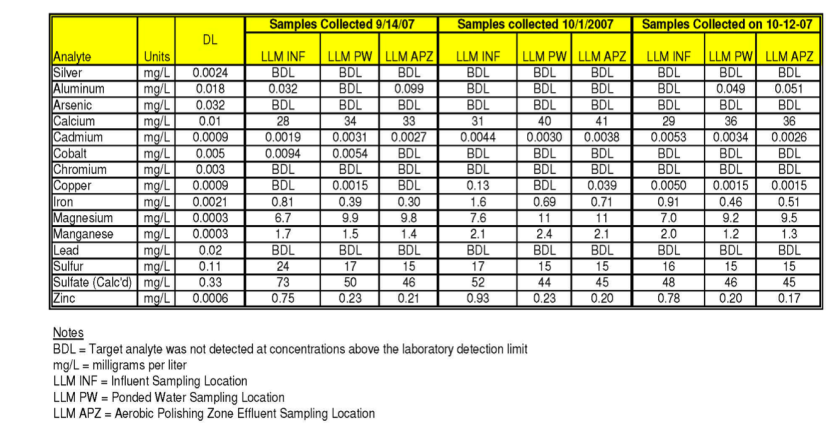
The Lady Leith design MIW (data from Sonle) was net neutral (pH 8.0 to 8.3) with minor amounts of iron (0.1 mg/L) and zinc (0.3 mg/L). Sulfate of 42 mg/L was considered borderline low for a sulfate reducing BCR. Actual values of iron and zinc were slightly above these concentrations (see Table 2), but not detrimentally so. Actual influent pH was about 6.6 s.u (see Table 1).
Table B.14-1. Field parameter measurements, Lady Leith Mine passive treatment system
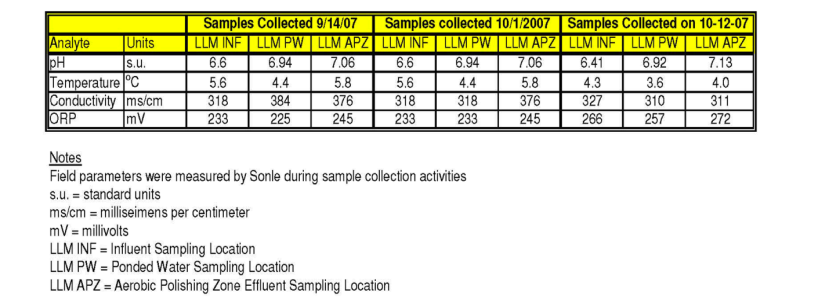
Table B.14-2. Summary of analytical laboratory results, Lady Leith Mine passive treatment system.
B.14.3 BCR Design
The BCR was designed to treat approximately six (6) gallons per minute (gpm) of Lady Leith MIW; flows exceeding this amount were designed to be by-passed and mixed with treated water on the surface of the BCR. The BCR was fully lined with geomembrane and constructed to appear like a natural fenFens are peat-forming wetlands that receive nutrients from sources other than precipitation, usually from upslope sources through drainage from surrounding mineral soils and from groundwater movement. Fens differ from bogs because they are less acidic and have higher nutrient levels. They are therefore able to support a much more diverse plant and animal community. These systems are often covered by grasses, sedges, rushes, and wildflowers. Some fens are characterized by parallel ridges of vegetation separated by less productive hollows. The ridges of these patterned fens form perpendicular to the downslope direction of water movement. Over time, peat may build up and separate the fen from its groundwater supply. When this happens, the fen receives fewer nutrients and may become a bog. See EPA website: http://water.epa.gov/type/wetlands/fen.cfm, or bottom-fed wetland. This approach was required to minimize damage from natural and human vandalism and assists in preserving the MIW temperature to improve bacterial activity in the system during the winter.
Two passive technologies were used to treat the Lady Leith MIW:
-
The BCR (SRBR) with a total bottom area of about 210 square feet was built in the area just down gradient from the Lady Leith Mine portal. The SRBR cell was filled to a depth of about 5.5 feet with a mixture of chipped wood, limestone sand, bacterial inoculum, and hay.
The treated MIW that ponded on the SRBR surface, containing biochemical oxygen demand (BOD)The amount of oxygen used as electron donor (food) is degraded by organisms. in addition to depressed dissolved oxygen levels, would flow by gravity across the SRBR surface to a spillway and thence into the receiving stream. The depth to the base of excavation may be as much as 7.5 feet; re-contouring may be required to achieve the recommended cell dimensions.
-
An aeration polishing zone (APZ) on the surface of the SRBR functions as a free water surface (FWS) wetland for the aeration of SRBR effluent and the removal of excess BOD.
MIW was to be collected in a bed of non-biodegradable Styrofoam shipping peanuts or other light-weight and inert material mixed with wood chips installed in the floor of the Lady Leith Mine collapsed portal; field fitting of this design feature was anticipated. The MIW was to be conveyed via a buried six-inch diameter high density polyethylene (HDPE) pipes to a buried flow control/diversion vault equipped with two four-inch diameter HDPEhigh density polyethylene pipes; one pipe will direct feed water to the bottom of the SRBR, the other will direct overflow to the surface of the SRBR. Flow control valves and clean-outs included in the design would facilitate periodic major maintenance (estimated to be on the order of several decades) to be performed. All flows were to be by gravity.
See Section B.14.10, Design Drawings for design details. Details of the substrateEither (a) a chemical which reacts or (b) a solid surface or (c) an electron donor. mixture follow.
|
Component |
Weight Recipe |
Approximate Unit Weights |
Order Vol. Units1 |
Volume Units |
Order Weight Units1 |
Weight Units |
|
|---|---|---|---|---|---|---|---|
|
Inoculum (mostly manure) |
10.0% |
37 |
PCF |
5.3 |
CY |
2.6 |
tons |
|
Chipped Wood A |
10.0% |
14.2 |
PCF |
13.6 |
CY |
2.6 |
tons |
|
Chipped Wood B |
40.0% |
10.6 |
PCF |
73 |
CY |
10.5 |
tons |
|
Limestone Sand |
30.0% |
95.6 |
PCF |
6.1 |
CY |
7.8 |
tons |
|
Hay |
10.0% |
80 |
Lbs/bale |
62 |
Bales |
2.6 |
tons |
|
Total |
100.0% |
|
|
|
|
|
tons |
| 1 Order quantities include a 5% safety factor CY = Cubic Yards |
|||||||
Chipped Wood A and B is comprised of hardwood and softwood particles generated from trees or other acceptable sources. Wood Chip A may be comprised of chips that are typically angular in shape to stringy, linear shapes generated by a grinding action in the chipping machinery. Wood Chip B is a fine-grained type of chipped wood.
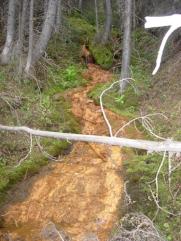
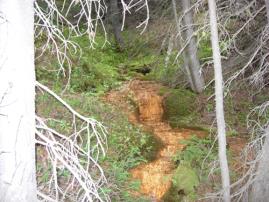
Pre-construction photos follow.
|
|
Source MIW |
|
2006 Excavation by Envirocon |
2006 Excavation by Envirocon |
|
2006 Excavation by Envirocon |
|
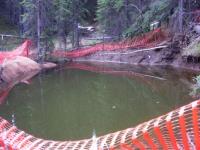
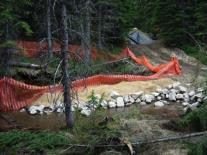
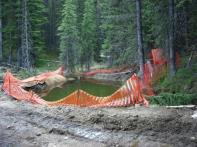
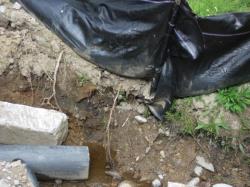
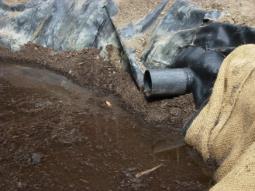
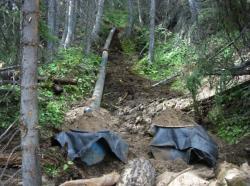
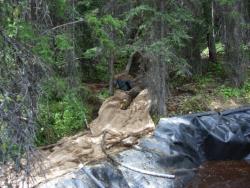
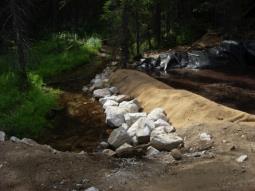
Construction photos follow.
|
|
|
|
|
|
|
|
|
|
|
|
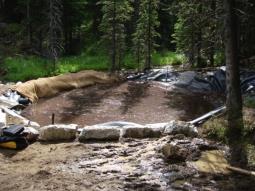
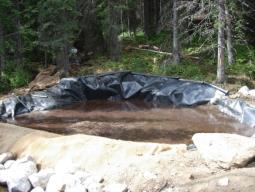
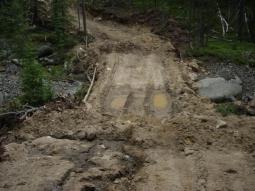
B.14.3.1 Pre- and Posttreatment Requirements
There were no pretreatment steps. However, keeping the MIW anoxic in the capture zone was a design goal (to minimize iron oxy-hydroxide formation and plugging.
The APZ, on the top of the BCR, was to serve as a polishing step for BOD and excess iron.
B.14.4 BCR Performance
See Tables B.14-1 and B.14-2, above. There were three post-construction sampling events in 2007 to evaluate startup. Unfortunately, monitoring was suspended following these events and performance cannot be determined.
B.14.5 BCR Monitoring
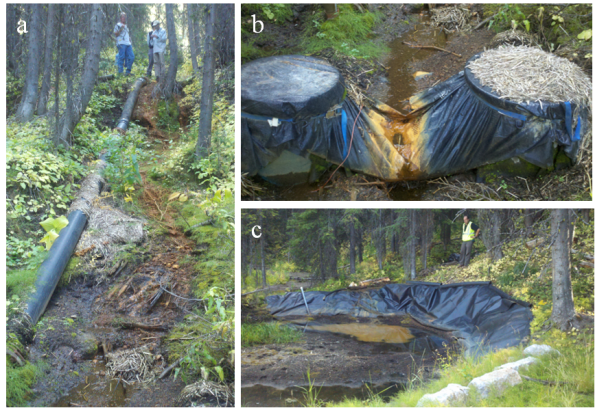
Other than three startup monitoring events in 2007 referenced above, it is unknown if the Lady Leith BCR has been monitored or even visited since then. The team visited the site in July of 2012 and found that the influent water transfer pipe had plugged (potentially from scaling). The influent was flowing on the exterior of the pipe (a) and over the flow control/diversion vault (b). The team was unsuccessful in repairing/unplugging the influent flow pipe so adjustments were made to divert the surface flow onto the geomembrane, thus entering the BCR from the top (c). Immediately following diversion of the influent into the surface of the BCR iron precipitation began as can be seen in photo (c).
B.14.6 Regulatory Challenges
Unknown.
B.14.7 Stakeholder Challenges
Unknown.
B.14.8 Other Challenges and Lessons Learned
If indeed, the system has not been visited or maintained since construction, the credo that passive treatment is low-maintenance, rather than no-maintenance, has apparently been ignored.
The upflow configuration was initially selected due to the cold climate at the site. Based on current experience, it would be better to bury the BCR with a top covering of plastic infiltration chambers typically used in septic systems.
B.14.9 References
Golder Associates, Inc., 2007. “Statement of Work and Construction Guidelines Lady Leith Mine Site Passive Treatment System”; prepared for: Sonle Technical Services P.O. Box 31; Elliston, MT 59728
Metesh, John et al., 1994. "Montana Bureau of Mines and Geology Open-File Report No. 321, Abandoned-Inactive Mines Program, Deerlodge National Forest, Vol. 1, Basin Creek Drainage. Prepared for the U.S. Dept. of Agriculture; Forest Service-Region 1. April 1994.
B.14.10 Design Drawings
 Figure B.14-1. Site plan view sketches, existing conditions
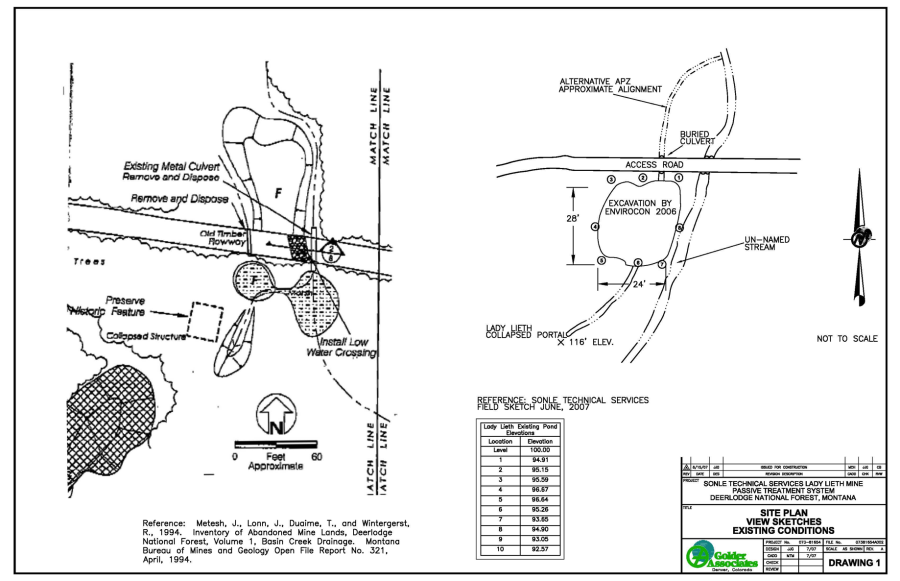
Figure B.14-1. Site plan view sketches, existing conditions
Figure B.14-2. System layout plan view.
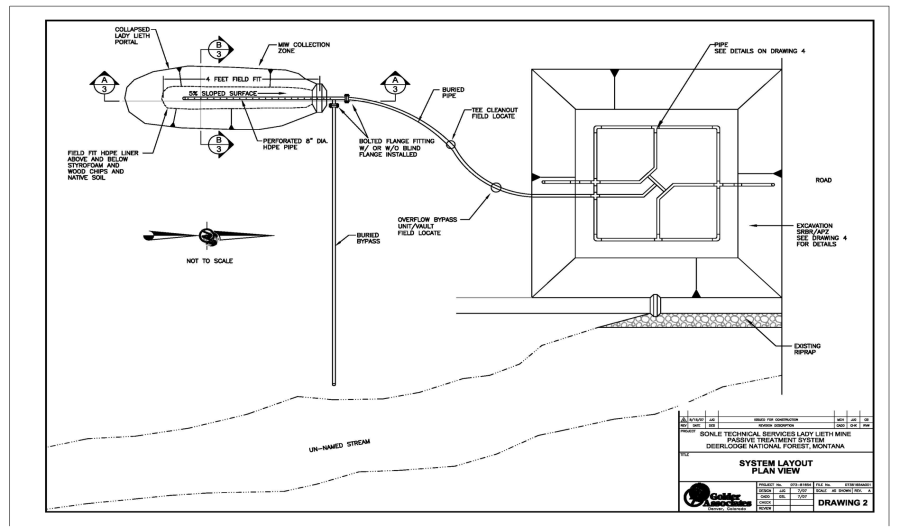
Figure B.14-2. System Layout Plan View
Figure B.14-3. MIW collection details
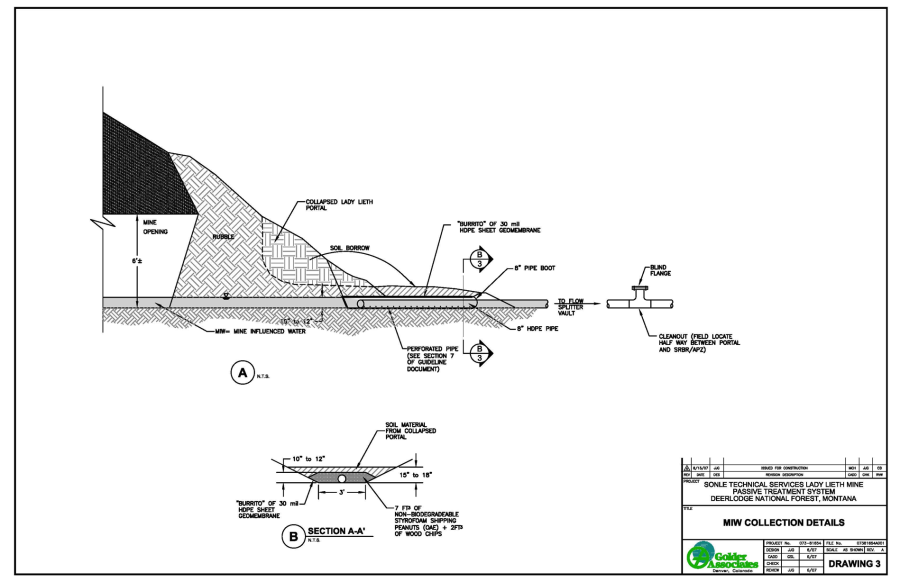 Figure B.14-3. MIW collection details
Figure B.14-4. Distribution piping layout, bottom of SRBR/APZ
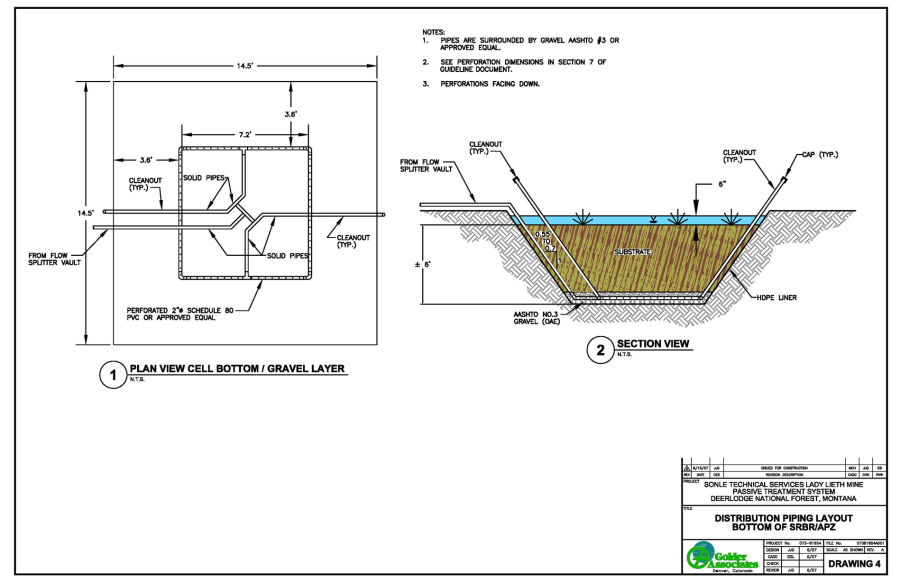
Figure B.14-4. Distribution piping layout, bottom of SRBR/APZ
Figure B.14-5. SRBR/APZ plan
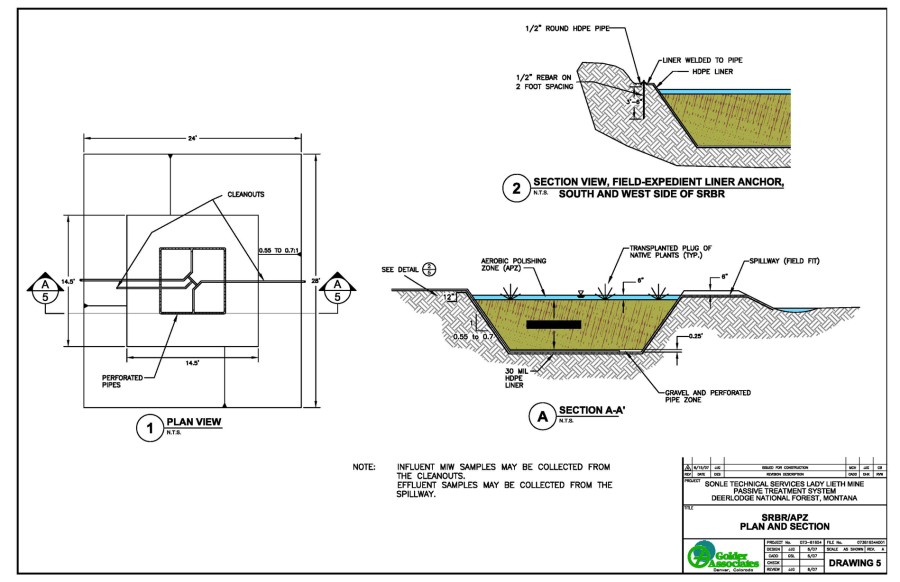
Figure B.14-5. SRBR/APZ plan.
Figure B.14-6. Plan view, overflow splitter unit.
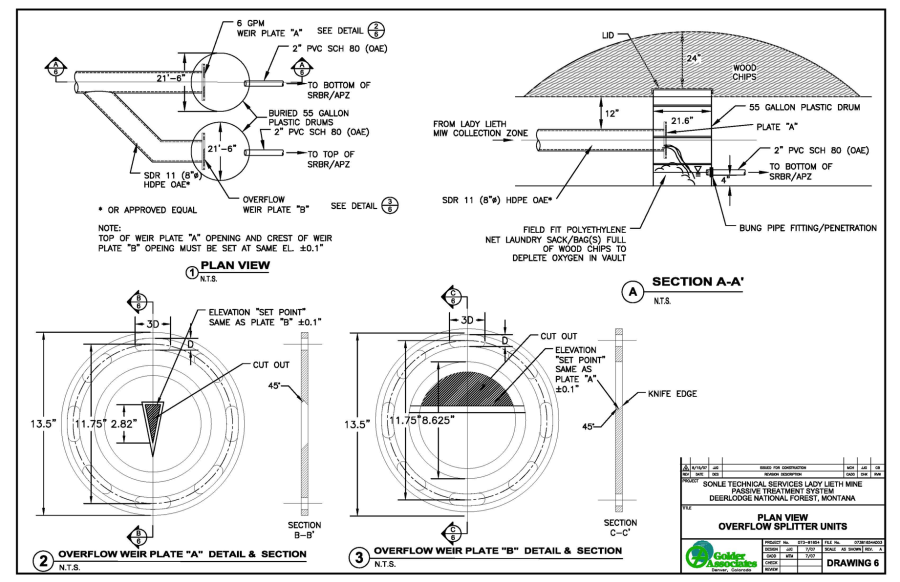
Figure B.14-6. Plan view overflow splitter unit.
Publication Date: November 2013